


FreeCell Solitaire: Mastering the 99% Winnable Game
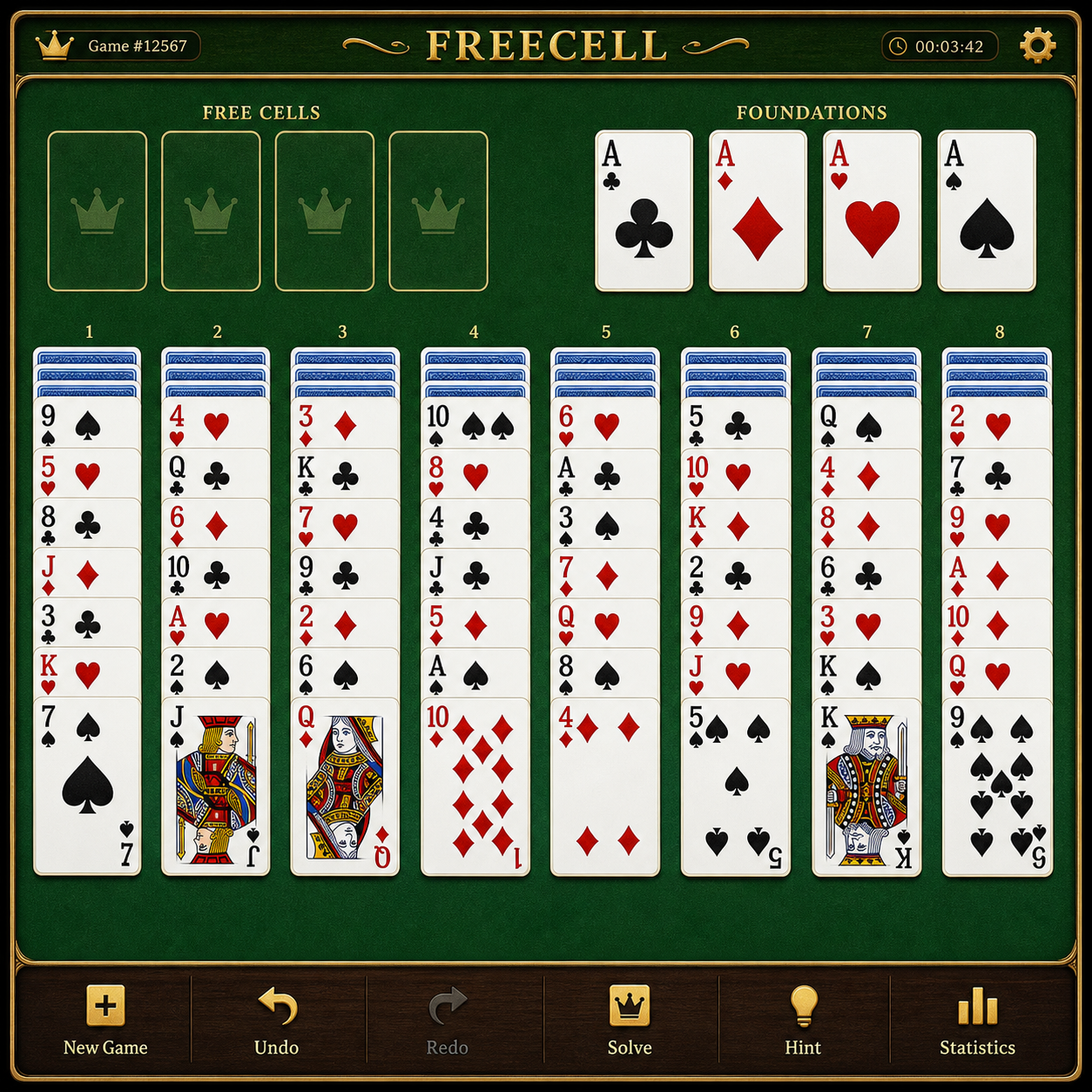
FreeCell Solitaire rewards careful thinking more than lucky draws. Because nearly every card is visible from the start, you can examine the tableau, plan several moves ahead, and solve many deals through deliberate decisions. The often-used description that FreeCell is a 99% winnable game reflects its unusually high solvability, not a guarantee that every deal can be completed.
What Makes FreeCell Different from Other Solitaire Games
FreeCell Solitaire is different because all cards are dealt face up, so success depends mainly on planning rather than hidden information or lucky stock-card draws. Its four free cells and open tableau give you control, but every temporary move has a cost.
In many solitaire games, the stock and waste piles conceal future cards. FreeCell has no stock pile or waste pile in the traditional layout. Instead, the challenge comes from deciding which visible card to uncover first and where to place cards without closing future routes.
The game combines short-term tactics with long-term structure. You may have a legal move available now, yet still reject it because it buries a low card, fills a free cell, or removes the only way to create an empty column. A strong player treats each open space as a resource.
This is why FreeCell can feel more difficult than luck-based solitaire even when a deal is theoretically solvable. The cards are known, but the number of possible consequences is large. A difficult position may require a careful sequence of temporary moves; an unsolvable deal may contain a structural blockage that no legal move can repair.
FreeCell Rules and Game Layout Explained
To play FreeCell, build four foundation piles upward by suit, arrange tableau cards downward in alternating colors, and use four free cells for temporary storage. You can move individual cards or valid building sequences when the destination and available spaces allow it.
The standard layout contains:
- Tableau: Eight cascades, or columns, holding all 52 cards at the beginning of the deal.
- Free cells: Four empty spaces in the upper-left area that can each hold one card.
- Foundation piles: Four piles, one for each suit, built from ace through king.
- Stock and waste piles: These are absent in standard FreeCell, unlike Klondike-style games.
Within the tableau, cards are placed in descending rank and alternating colors. For example, a black seven can be placed on a red eight, while a red queen can be placed on a black king. You may move a single exposed card to a free cell, an empty column, or a suitable card in another cascade.
You can also move a building sequence, such as a black nine, red eight, and black seven, provided the sequence is already correctly arranged. The maximum number of cards you can move as one unit depends on the number of empty free cells and empty columns available. In simplified form, the movable sequence limit is:
(number of empty free cells + 1) × 2number of empty columns
That formula assumes the destination column is occupied. An empty destination column gives you additional flexibility, but only a king, or a sequence beginning with a king in some rule sets, can usually be placed there.
Cards move to the foundations in suit order. An ace starts a foundation, followed by the two, three, and so on through the king. Foundation moves are permanent in practical terms, so make sure removing a card will not disrupt an important tableau sequence.
The Essential Strategy: Plan Before You Move
To plan effectively in FreeCell, scan the tableau first, identify blocked cards, and choose moves that increase future options rather than merely making immediate progress. The best move often creates access to several cards at once.
Begin with a quick layout scan. Look for aces and twos, cards buried beneath long stacks, kings trapped in crowded cascades, and cards that can be moved only after a specific blocker disappears. This gives you a map of the deal before you commit valuable spaces.
Use a three-question move check
- What does this move uncover? Prefer moves that expose a new card, especially an ace, low card, or king.
- What does this move consume? Count the free cells, empty columns, and useful destinations it takes away.
- What is the next consequence? Confirm that the newly exposed card has somewhere productive to go.
Suppose you can move a red six onto a black seven, uncovering a red five. That may be useful if the five can immediately join a black six elsewhere. If the move only transfers a card while leaving the red five trapped, it may spend flexibility without improving the position.
Think in short sequences rather than isolated moves. A good plan might be: move a blocker to a free cell, uncover an ace, send the ace to its foundation, then use the freed tableau space to rearrange a longer sequence. This type of chain is more valuable than a move that simply makes one column look tidy.
When learning, use the undo function as a planning tool. Reverse a move after three or four consequences and compare the position with the original. Undo should reveal cause and effect, not encourage random trial and error.
How to Use Free Cells and Empty Columns Wisely
Free cells and empty columns are temporary storage spaces that make larger moves possible, so use them to unlock cards rather than as convenient parking spots. Preserving at least one open space often keeps a difficult deal manageable.
A free cell can hold a single card while you access a card beneath it. That sounds harmless, but four occupied free cells leave no room for emergency transfers. Filling them early is like closing every spare lane on a narrow road: the board may still look active, but movement becomes restricted.
Empty columns are more powerful because they can hold a king or support a larger rearrangement. Creating one usually requires moving every card out of a cascade. Before doing so, ask whether the empty column will:
- Receive a trapped king;
- Allow a long building sequence to shift;
- Expose several important cards;
- Support a later transfer after another cascade is cleared.
The relationship between spaces and sequences matters. With four empty free cells and no empty columns, you can often move a sequence of five cards. With fewer free cells, that capacity falls quickly. An empty column can multiply your moving power, which is why creating one at the right moment can change the entire deal.
Do not automatically clear the shortest cascade. Clear the column that produces the greatest strategic benefit. A short column containing a useful king may be more valuable intact than a longer column hiding an ace.
Building Foundations Without Blocking the Tableau
Build foundation piles steadily when cards are safely available, but avoid sending tableau cards upward simply because the move is legal. Foundation progress helps only when it also preserves access and movement across the tableau.
Aces and twos are usually strong early foundation candidates because they rarely serve as essential supports for lower cards. Higher cards require more judgment. Moving a red six to its foundation may be correct, but it could also remove the card needed to place a black five or organize a critical sequence.
Use a simple foundation test:
- Is the card already exposed or easy to expose?
- Will removing it uncover a useful card?
- Do you still have access to the opposite-color cards that depend on it?
- Does the move preserve enough flexibility for the next rearrangement?
Foundation piles can also serve as a progress indicator. If you have advanced several suits while the tableau remains crowded, pause and check whether you are removing cards too quickly. FreeCell is won by clearing the tableau, not by maximizing foundation movement at every turn.
A useful rule is to develop the tableau first, then accelerate foundation play once the necessary low cards are accessible. The correct timing varies by deal, especially when a foundation card is also a key tableau connector.
Common FreeCell Mistakes and How to Avoid Them
The most common FreeCell mistakes are spending storage spaces too early, making purposeless transfers, burying low cards, and planning only one move ahead. Correcting these habits improves both accuracy and win rate.
Filling all four free cells too soon
The error: Players move any inconvenient card into an open cell. Why it happens: The move immediately clears a tableau position. Consequence: A later sequence cannot be rearranged, and one blocked card can stop the deal. Correction: Reserve free cells for cards that unlock a specific target, and aim to keep at least one available whenever possible.
Moving sequences without a purpose
The error: A long building sequence moves from one cascade to another simply because the destination is legal. Why it happens: The transfer feels like progress. Consequence: You consume spaces and may bury a card that was easier to reach before. Correction: Move a sequence only if it uncovers a card, creates an empty column, improves access, or supports a clear foundation plan.
Burying low cards
The error: Aces, twos, and threes become trapped beneath higher tableau cards. Why it happens: The player focuses on neat descending sequences rather than foundation access. Consequence: Foundation development stalls and the tableau loses flexibility. Correction: Track low cards from the beginning and prioritize moves that expose them.
Ignoring future destinations
The error: A card is uncovered without checking where it can go next. Why it happens: Uncovering any card appears beneficial. Consequence: The newly exposed card occupies a free cell or remains stranded in a cascade. Correction: Before moving, identify at least one likely destination for the card you will reveal.
A Practical Method for Solving Difficult Deals
To solve a difficult FreeCell deal, repeat a five-stage process: scan the layout, prioritize blocked cards, create useful space, review consequences, and undo only when the resulting position is weaker.
- Scan the layout. Locate all aces, low cards, kings, buried cards, and available legal moves. Do not begin with speed.
- Prioritize blockers. Focus on cards preventing access to foundations, empty columns, or important building sequences. A card that blocks three useful cards deserves attention before one that blocks a single ordinary card.
- Create space deliberately. Empty a cascade or use a free cell only when the space supports a known follow-up. Space without a destination is temporary relief, not a plan.
- Review consequences. After each significant move, reassess the free cells, empty columns, foundation progress, and accessible tableau cards. The board has changed; your original plan may need adjustment.
- Use undo deliberately. If a line fails, step back to the last meaningful decision rather than repeatedly reversing single moves. Compare alternatives and record which card became inaccessible.
For beginners, a useful goal is to improve flexibility before speed. Try to finish a deal with unused free-cell capacity and at least one clear route through the tableau. Once your decisions become consistent, speed usually improves naturally because you spend less time repairing avoidable blockages.
Some deals may still resist careful play. A difficult position is not proof that your strategy failed, and the widely repeated 99% solvability claim should be treated as an informal description rather than a universal statistic. Your job is to preserve options long enough to distinguish a temporary obstacle from a genuinely unsolvable arrangement.
FreeCell Solitaire Frequently Asked Questions
FreeCell Solitaire questions usually center on solvability, first moves, sequence limits, empty columns, and whether undo is acceptable during practice.
Is every FreeCell Solitaire game winnable?
No. Most commonly generated deals are considered highly solvable, and some numbered versions are known to be solvable, but no general rule makes every deal winnable. A failed game may result from an early mistake or from an inherently unsolvable layout.
What is the best first move in FreeCell?
There is no universal best first move. Favor a move that exposes an ace or low card, uncovers a major blocker, creates a useful empty column, or opens a clear sequence of follow-up moves.
How many cards can be moved at once?
The number depends on available free cells and empty columns. With no empty free cells or columns, you normally move one card. More open spaces increase the size of a movable building sequence according to the standard FreeCell movement formula.
When should you use an empty column?
Use an empty column when it can receive a trapped king, support a long sequence transfer, or expose valuable cards. Creating an empty column without a follow-up plan may waste several moves.
Does using the undo button reduce skill or strategy?
No. Undo can be a valuable learning aid when you use it to study consequences and compare plans. It becomes unhelpful only when it replaces deliberate thinking with unlimited random experimentation.