


Pyramid Solitaire: Rules, Scoring, and Winning Tactics
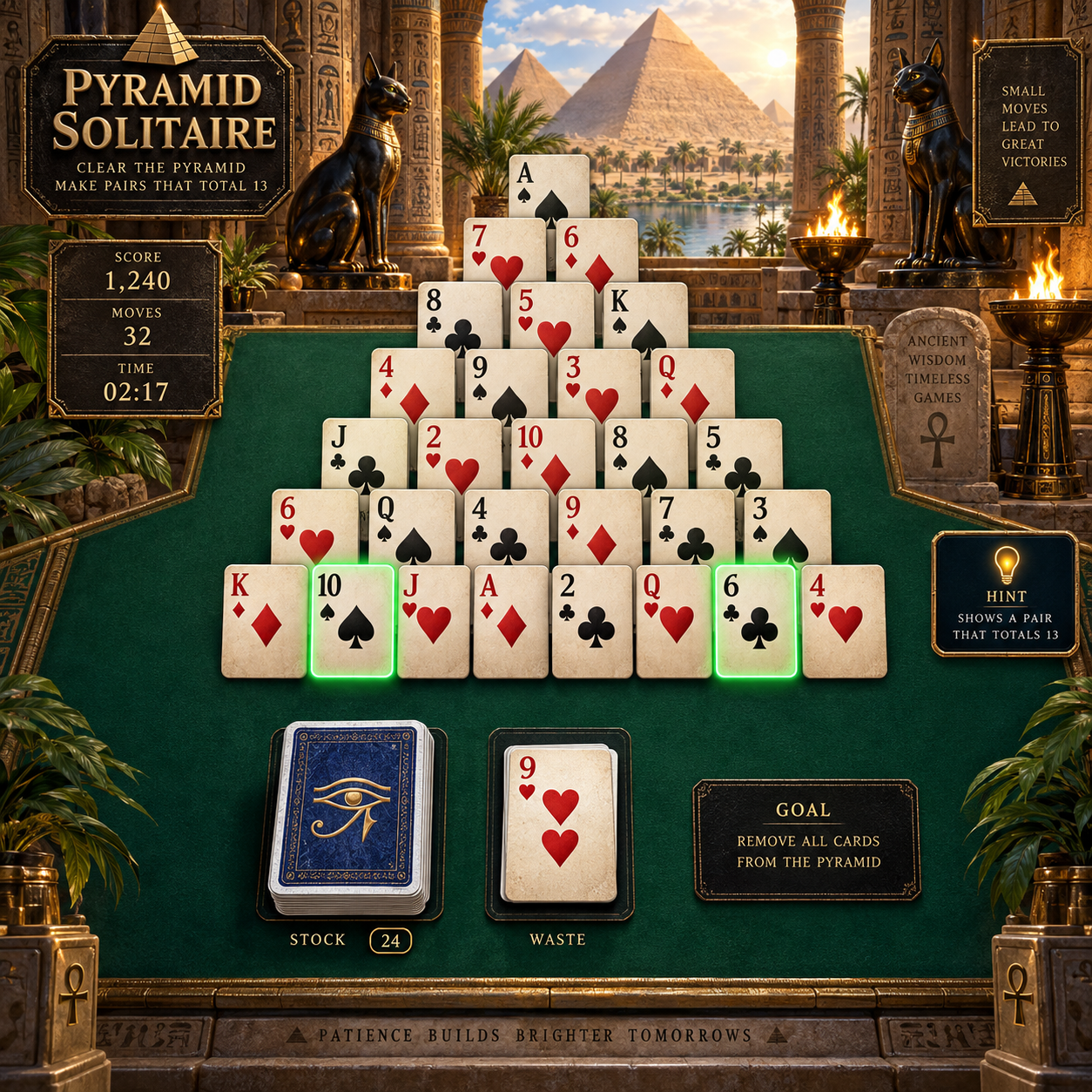
Pyramid Solitaire is a matching card game built around one simple objective: remove pairs of exposed cards that add up to 13 until you clear the pyramid. The challenge comes from deciding which legal move reveals the most useful hidden cards while preserving enough options for the endgame.
What Is Pyramid Solitaire?
Pyramid Solitaire is a solitaire card game in which players remove pairs of available cards with a combined value of 13. The main goal is to clear the pyramid tableau, although some versions also require you to use the stock or remove every card from the layout.
The game usually begins with 28 cards arranged in seven overlapping rows. The bottom row contains seven cards, the next row contains six, and each higher row contains one fewer card until the single card at the top. Cards overlap, so most of the tableau starts hidden.
This layout creates the defining tension of Pyramid Solitaire. A card can be legally paired only when it is exposed, meaning no other cards cover it. Removing a pair may uncover new cards, but a tempting move can also consume the only card needed to unlock an important section later.
Unlike foundation-building games such as Klondike, Pyramid Solitaire does not ask you to build suits in ascending or descending order. Every move is a calculation involving card values, access, and timing.
Pyramid Solitaire Setup and Card Layout
The standard Pyramid Solitaire setup uses a 52-card deck, a 28-card pyramid tableau, and a stock from which additional cards are revealed. The waste pile receives cards drawn from the stock and supplies extra pairing opportunities when the tableau has limited moves.
The tableau is dealt face up in a pyramid pattern. Cards in the lowest row are initially exposed because nothing covers them. Cards above them are blocked by the two cards directly beneath them and become available only after both covering cards have been removed.
The remaining deck forms the stock. Depending on the version, you turn over one stock card at a time or draw three cards in sequence. Each revealed stock card moves to the waste pile, where it may be paired with an exposed tableau card or, in many versions, with another suitable waste card.
- Tableau: The pyramid of overlapping cards that you are trying to clear.
- Exposed cards: Cards with no cards covering them and therefore eligible for play.
- Stock: The undealt cards used to provide additional moves.
- Waste pile: The face-up pile containing cards removed from the stock.
Some online versions allow the stock to be recycled, while others permit only one pass. Check the specific game instructions before planning a long sequence, because stock rules strongly affect the difficulty.
Pyramid Solitaire Rules and Legal Moves
To make a legal move in Pyramid Solitaire, select two exposed cards whose values total 13, or remove an exposed King by itself. Number cards keep their printed values, face cards have fixed values, and an Ace counts as 1.
The card values are:
- Ace: 1
- 2 through 10: Their printed values
- Jack: 11
- Queen: 12
- King: 13
The valid pairs are therefore:
- Ace and Queen
- 2 and Jack
- 3 and 10
- 4 and 9
- 5 and 8
- 6 and 7
A King is worth 13 on its own, so you can remove it without pairing it with another card. This rule makes Kings valuable for opening blocked areas, but removing one too quickly can sometimes waste a useful way to control the board if your version rewards longer sequences or cleared pairs.
Cards may usually be paired across the tableau, between the tableau and waste pile, or within the waste pile when the game permits that option. A covered card is never available, even if its value would complete a pair. For example, a visible 5 cannot be used with a 8 if either card is still covered by another tableau card.
When playing online, click or tap the first card and then its matching partner. In a physical game, remove the cards from the layout and keep discarded pairs separate from the waste pile.
How Scoring Works
Pyramid Solitaire scoring varies by version, but most systems award points for removing pairs, clearing pyramid cards, and completing the game while penalizing excessive stock use or time. Always treat the displayed score rules as authoritative for the specific app or website.
A common scoring model rewards each removed pair with a fixed number of points. Some games give extra credit for removing cards from the pyramid rather than from the waste pile, because tableau cards are the main obstacle. Clearing the entire pyramid may trigger a completion bonus.
Other versions track progress through simpler measures:
- The number of cards removed from the tableau
- The number of stock cards used
- The number of passes through the stock
- The length of an uninterrupted removal streak
- The time taken to finish the layout
These systems create different priorities. If the score rewards speed, a quick legal pair may be sensible. If it rewards stock conservation, you should search the tableau carefully before drawing. If it rewards streaks, avoid unnecessary pauses between valid removals.
Scoring should support your decision-making rather than replace it. A high-value move that leaves the pyramid locked is usually worse than a lower-scoring move that exposes two new cards and preserves several future pairs.
Winning Tactics and Common Mistakes
The strongest winning strategy is to prioritize moves that uncover covered cards while preserving multiple future pairings. Stock management, careful use of Kings, and forward planning matter more than simply taking the first available pair.
Prioritize blocked cards
When choosing between two legal pairs, favor the move that removes cards from the lower rows and exposes cards above them. A pair involving two waste cards may be legal, but it does little to develop the tableau. A pair that removes one or both cards covering the next row usually has greater strategic value.
Plan around scarce values
Some cards have fewer practical partners at a given moment. If the only exposed Queen is paired with an Ace, consider whether that Ace is needed to remove another Queen that blocks a critical section. Think in terms of future access, not just immediate removal.
For example, if an exposed 6 can pair with either a 7 in the tableau or a 7 in the waste pile, the tableau pairing is often stronger because it removes a blocker. However, if the tableau 7 is also covering a valuable card and the waste 7 will disappear when the stock changes, the correct choice depends on the sequence of future draws.
Use the stock deliberately
Do not draw from the stock automatically after every move. First inspect every available tableau pair. Drawing too early can move a useful card into the waste pile before you have used it, while a no-recycle stock can make that card unreachable later.
Handle Kings with purpose
Because a King can be removed alone, it is often the easiest card to play. That does not always make it the best first move. Remove a King when it uncovers important cards or prevents the King from blocking a needed pair. If the King is isolated and removal changes nothing, you may gain more by developing another part of the pyramid.
Common mistakes to avoid
- Taking the first legal pair: Players make this mistake because any removal feels productive. The consequence is lost flexibility. Compare at least two available moves before committing.
- Ignoring the tableau: Pairing stock cards repeatedly can leave the pyramid untouched. Use waste cards to unlock tableau sections whenever possible.
- Spending a unique partner too early: A Queen may have only one accessible Ace. Before pairing it, check whether another Queen is blocked and needs that Ace more urgently.
- Assuming every deal is winnable: Some deals become impossible because key partners remain buried or the stock sequence provides no access. Good tactics improve your odds; they cannot guarantee every game.

Step-by-Step Approach to a Stronger Game
To play a stronger Pyramid Solitaire game, scan the tableau, rank moves by the cards they reveal, reserve scarce partners, and use the stock only when it improves your available choices.
- Map the exposed cards. Identify every legal pair and every available King before making a move. This takes only a few seconds and prevents impulsive play.
- Mark the blockers. Look at the lower rows that cover the most cards. Removing these cards usually produces more information than removing isolated waste cards.
- Compare the next reveal. If one move exposes two cards and another exposes one, prefer the first unless it consumes a partner needed elsewhere.
- Preserve flexibility. When two moves have similar benefits, choose the one that leaves more exposed cards with different possible partners.
- Sequence dependent moves. Sometimes you must remove one pair before another becomes legal. Complete the unlocking move first, even if the second pair looks more attractive.
- Use the stock as a resource. Draw only after checking the tableau. Keep track of cards that have appeared so you know whether a missing partner may still be available.
- Review the position after each reveal. A newly exposed card can change the best plan. Recalculate rather than following an old sequence automatically.
A useful mental model is the Access-Flexibility-Exit test: does the move increase access to covered cards, preserve several future pairs, and leave a workable stock path? A move that satisfies two of these three conditions may be acceptable; a move that satisfies none is usually a warning sign.
When You Are Stuck: Options and Endgame Decisions
When you are stuck in Pyramid Solitaire, reassess every exposed card, inspect the waste pile, use the remaining stock carefully, and consider an undo move if the version provides one. A position may look dead while still containing a missed King or an overlooked pairing combination.
Start with a complete scan rather than focusing on the last card you played. Check all pairs, including tableau-to-tableau, tableau-to-waste, and any waste-to-waste combinations allowed by the rules. Confirm that a card is genuinely exposed; overlapping edges can make a covered card appear playable.
If the stock remains, reveal the next card only after deciding what you hope it will accomplish. A new card may unlock a pair, but it may also bury a useful waste card beneath an inaccessible sequence. In draw-three versions, remember that the order of waste cards can matter more than the individual values.
An undo move is useful for learning and analysis, especially when you are testing whether a different sequence preserves access to the pyramid. Use it to compare choices, not to erase every consequence until the game becomes meaningless. If you are playing competitively or under a no-undo challenge, treat the feature as unavailable.
Recognize an unwinnable position when every remaining tableau card depends on a partner that has already been removed, buried beyond the available stock passes, or trapped under cards that cannot be cleared. At that point, restarting may be more productive than repeating the same sequence. Review the decision that created the lock: it often involved using a scarce partner or ignoring a blocker earlier.
Frequently Asked Questions
What is the goal of Pyramid Solitaire?
The goal is to remove the entire pyramid by pairing exposed cards that total 13. Many versions also require you to manage or exhaust the stock.
Which cards can be paired in Pyramid Solitaire?
The valid pairs are Ace and Queen, 2 and Jack, 3 and 10, 4 and 9, 5 and 8, and 6 and 7. Both cards must be exposed, unless a version states a different rule.
What is the value of a King in Pyramid Solitaire?
A King is worth 13 and can be removed by itself. It does not need a matching card.
Can every Pyramid Solitaire game be won?
No. The deal, stock order, and game rules can create positions with no possible solution. Careful play improves your chances but cannot guarantee a win.
How can I improve my Pyramid Solitaire score?
Clear tableau cards efficiently, limit unnecessary stock use, preserve useful partners, and follow the scoring rules of your specific version. A fast move is valuable only when it does not damage your route through the pyramid.
Pyramid Solitaire rewards patience more than speed. Learn the card values, inspect the full layout, expose blocked cards early, and treat every partner as a limited resource. With that habit, your decisions become clearer and your winning opportunities easier to recognize.