The Mental Health and Focus Benefits of Playing Solitaire
Why Solitaire Is More Than Just a Card Game
Solitaire is a genuine cognitive workout disguised as a casual pastime. What looks like idle card-flipping is actually a structured mental exercise that engages planning, decision-making, and pattern recognition — all within a few quiet minutes.
For decades, solitaire was the game pre-installed on every Windows computer, and millions played it without thinking much about why it felt so satisfying. The answer lies in how the game is built. Every move in Klondike solitaire or FreeCell requires you to evaluate options, anticipate consequences, and commit to a strategy. That's not trivial — that's exactly the kind of mental engagement that keeps the brain active and alert.
Solo gameplay removes the social pressure of competing against others. There's no opponent to outsmart, no clock ticking down with someone watching. This low-stakes environment is part of what makes solitaire uniquely accessible as a mental wellness tool. You need no equipment beyond a deck of cards or a phone, no partner, and no particular skill level to start benefiting.
How Solitaire Sharpens Focus and Concentration
Solitaire trains focused attention by requiring players to track multiple card positions and sequences simultaneously — a demand that naturally pulls the mind away from distraction.
Think about what happens when you sit down with a game of Spider Solitaire. You're managing eight columns of cards, looking for sequences, and planning several moves ahead. Your attention has to stay on the board. Drift off mentally, and you'll miss a key move or create a dead end. The game gently punishes inattention and rewards sustained focus.
This is different from passively scrolling a feed or watching a video. Solitaire demands active engagement — your brain has to participate, not just receive. Over repeated sessions, this kind of structured attention practice can make it easier to concentrate in other areas of life too, from reading to work tasks.
Short, regular sessions seem to matter more than marathon play. Even 15–20 minutes of deliberate solitaire can function as a focus warm-up before tackling demanding cognitive work.
Solitaire as a Tool for Stress Relief and Relaxation
Playing solitaire reduces stress by giving the mind a single, manageable task to focus on — which interrupts the cycle of anxious or scattered thinking.
The repetitive, rhythmic nature of card games creates a predictable mental rhythm. Flip a card, assess the options, make a move. That loop is calming in the same way that some people find knitting or jigsaw puzzles soothing. The structure itself is the relief — it replaces open-ended worry with a defined, solvable problem.

Unlike high-stimulation mobile games with flashing rewards and competitive leaderboards, solitaire operates at your pace. There's no pressure to react instantly or outperform anyone. That absence of urgency is precisely what makes it effective for stress relief. Your nervous system gets a break from the constant demand to perform.
Many players describe finishing a game — win or lose — feeling noticeably calmer than when they started. That's not coincidence. The focused, low-pressure nature of single-player card games creates real psychological breathing room.
Cognitive Benefits — Memory, Planning, and Problem-Solving
Solitaire exercises three core cognitive functions: working memory, sequential planning, and problem-solving — all within a single game session.
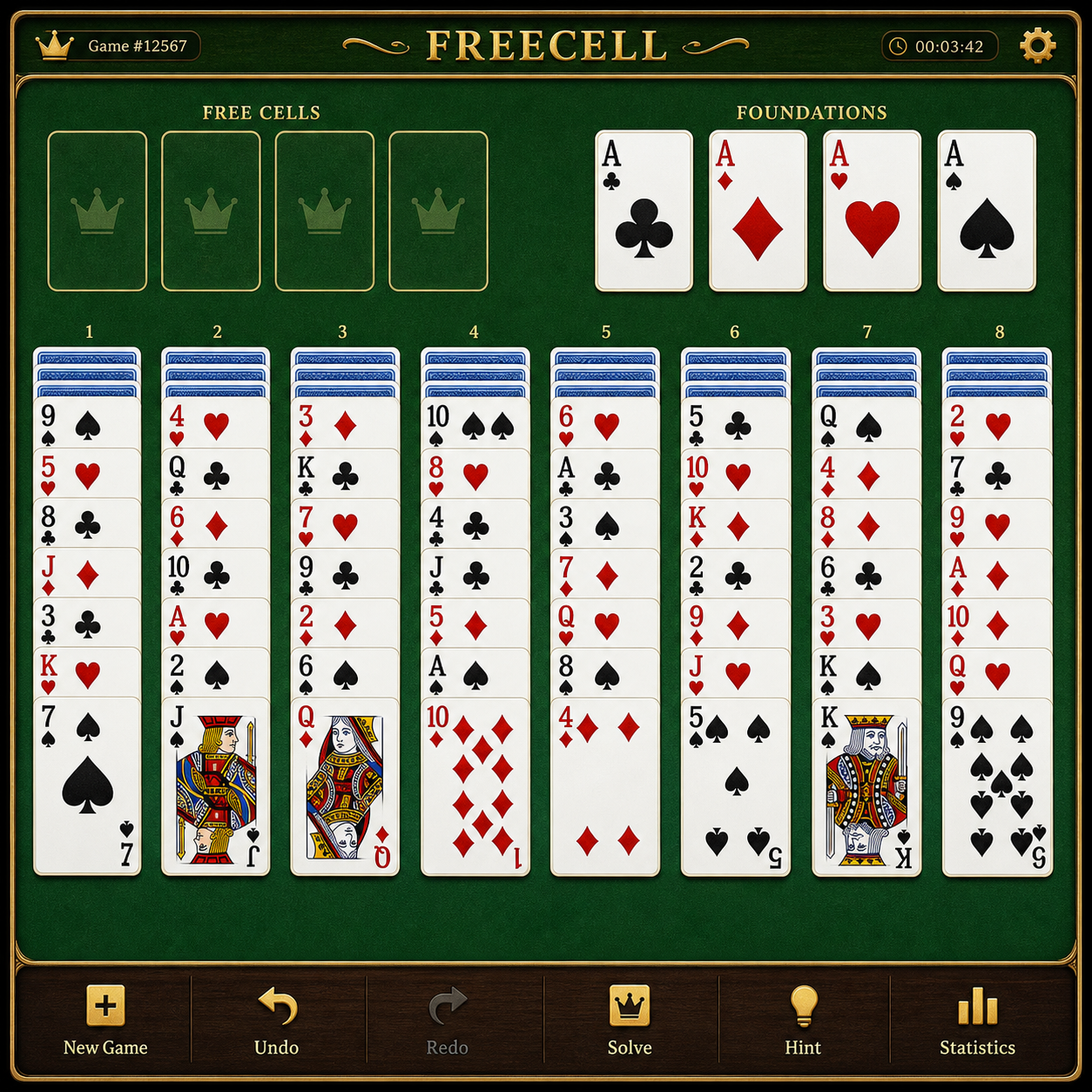
Working memory gets a workout every time you remember which cards are hidden face-down, track which suits you've already moved to the foundation, and hold multiple possible move sequences in your head at once. FreeCell, in particular, is demanding in this regard — nearly every game is solvable, but only if you think several steps ahead rather than playing reactively.
Planning and sequencing are equally central. Building a valid sequence in Klondike isn't random — it requires forward thinking. You're constantly asking: if I move this card now, does it open a better opportunity or close one off? That kind of conditional reasoning is the same cognitive muscle used in project planning, budgeting, and everyday decision-making.
Pattern recognition develops naturally as you play more. Experienced players start to see card configurations and immediately recognize whether a position is promising or a dead end. This skill — reading patterns quickly and accurately — transfers to many real-world contexts, from reading spreadsheets to spotting errors in written text.
Solitaire and Mindfulness — A Meditative Solo Experience
Solitaire can function as an informal mindfulness practice because it anchors attention to the present moment, leaving little mental room for rumination or distraction.
Mindfulness, in its most practical form, means keeping your attention on what's happening right now rather than replaying the past or rehearsing the future. Solitaire creates exactly that condition. When you're deciding whether to move a red seven onto a black eight, your attention is fully in that moment. The game doesn't allow much mental wandering.
This is why some players find solitaire more restorative than traditional meditation — it gives the restless mind something concrete to do while still achieving that quiet, present-moment focus. For people who struggle to "just sit and breathe," the gentle structure of a card game offers an accessible alternative path to the same mental stillness.
The solo nature of the game matters here too. Without a social dimension, there's no performance anxiety, no need to manage someone else's reactions. It's just you, the cards, and the quiet satisfaction of working through a problem at your own pace.
Can Solitaire Help with Mental Fatigue and Brain Recovery?
Yes — short solitaire sessions can serve as an effective mental reset between cognitively demanding tasks, helping the brain recover without fully disengaging.
Mental fatigue sets in when we sustain high-effort thinking for too long without a break. The temptation is to reach for passive distraction — social media, TV, aimless browsing. But research into attention restoration suggests that mildly engaging activities work better for cognitive recovery than complete mental disengagement.
Solitaire hits that middle ground well. It's engaging enough to pull attention away from work stress, but not so demanding that it exhausts the same mental resources you're trying to restore. A 10–15 minute game between focused work blocks can feel like a genuine mental exhale — you return to the next task with more clarity than if you'd simply stared at your phone.
This makes solitaire particularly useful during long workdays or study sessions. Rather than a 30-minute social media scroll that leaves you feeling more scattered, a couple of games of Klondike or FreeCell can act as a structured cognitive break that actually refreshes your concentration.
Tips for Getting the Most Mental Health Value from Solitaire
To maximize the mental health benefits of solitaire, play with intention rather than habit — small adjustments to how and when you play make a significant difference.
- Set a time boundary. Decide before you start whether you're playing one game or 20 minutes. This keeps solitaire a purposeful break rather than an accidental hour lost.
- Choose the right variant for your goal. FreeCell rewards deep planning and is best when you want cognitive stimulation. Klondike is more luck-influenced and better for casual stress relief. Spider Solitaire sits in the middle — complex enough to engage, but not overwhelming.
- Play without auto-hints. Resisting the hint button forces your brain to work harder, which is where the real cognitive benefit lives. Think of hints as training wheels — useful for learning, but worth removing once you're comfortable.
- Use solitaire as a transition ritual. Playing a single game before switching from one type of work to another can help the brain shift modes more smoothly, acting as a mental palate cleanser.
- Notice how you feel before and after. Paying attention to your mental state at the start and end of a session builds awareness of how the game affects you personally — which is the foundation of using any activity intentionally for wellbeing.
The goal isn't to win every game. It's to use the game as a tool — for focus, for calm, for mental recovery. Approached that way, even a losing hand has value.
Frequently Asked Questions
Is playing solitaire good for your brain?
Yes. Solitaire engages working memory, pattern recognition, and strategic planning — all core components of cognitive function. Regular play keeps these mental faculties active in a low-pressure, enjoyable format.
How long should you play solitaire to see mental benefits?
Even 10–20 minutes per session can provide noticeable benefits, particularly for stress relief and focus. Consistency matters more than duration — short daily sessions outperform occasional long ones for building cognitive habits.
Is solitaire better for mental health than other mobile games?
For calm focus and stress relief, solitaire has an edge over high-stimulation games that rely on rapid reactions and competitive pressure. Its low-urgency structure makes it genuinely restorative rather than just distracting.
Can solitaire help with anxiety or stress?
Many players find that solitaire interrupts anxious thought patterns by giving the mind a single, manageable problem to solve. It won't replace professional support for clinical anxiety, but as a daily calming tool, it's both accessible and effective.
What type of solitaire is best for improving focus?
FreeCell is widely considered the most cognitively demanding variant, making it the best choice for sharpening focus and planning skills. Klondike is better for relaxation, while Spider Solitaire offers a balanced challenge suitable for both goals.