
Solitaire Tournaments: How Competitive Play Works
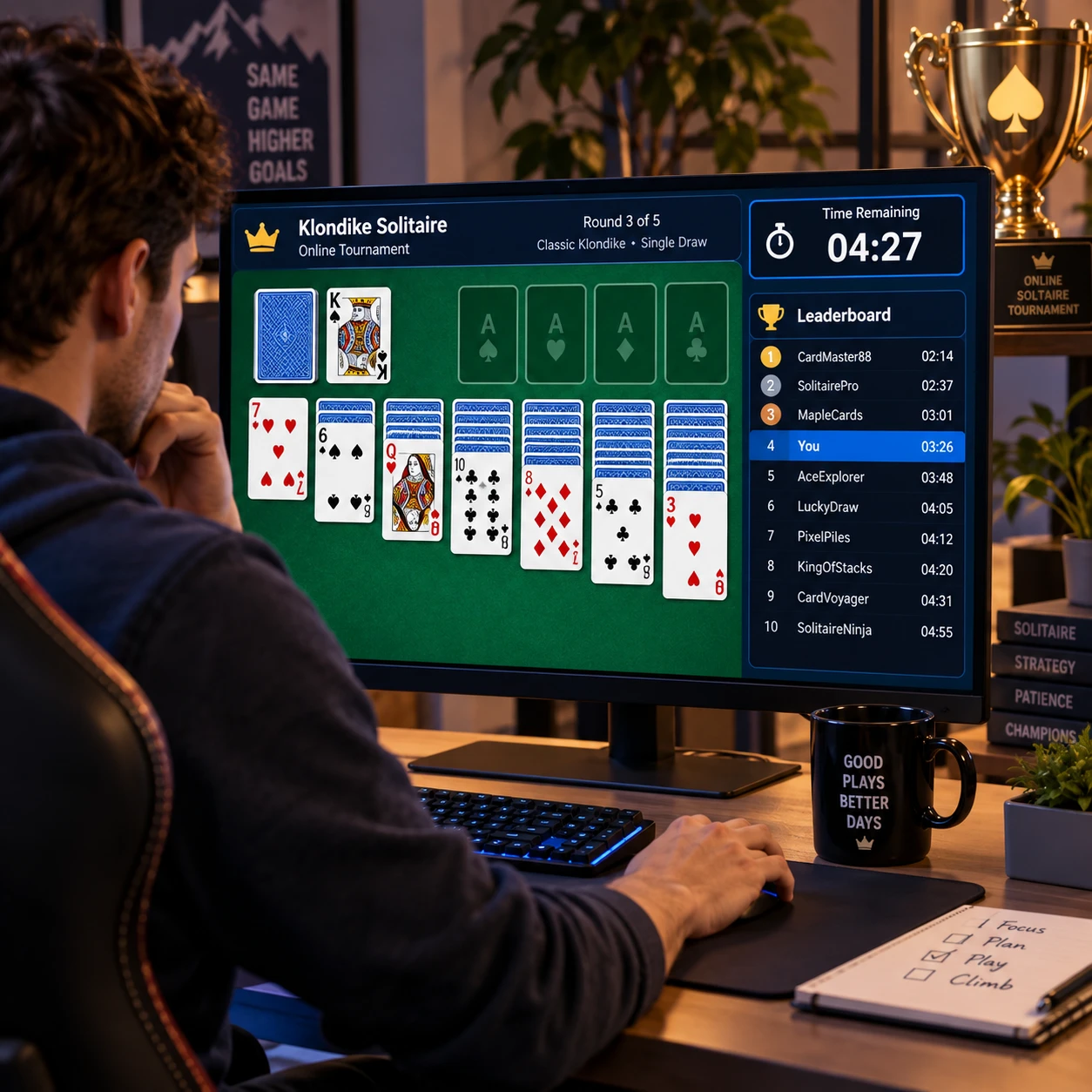
Solitaire tournaments turn a familiar solo card game into a contest of pace, accuracy, and planning. Players may solve the same deal, race against a clock, earn points for moves, or compare results across separate games. The exact rules depend on the event, so knowing the tournament format and scoring system matters as much as knowing how to move a card.
What Is a Solitaire Tournament?
A solitaire tournament is an organized competition in which players complete solitaire games under shared rules and have their results ranked. Unlike casual play, a tournament sets conditions such as the game version, deal, time limit, scoring system, and method for confirming results.
Competitive solitaire still rewards sound play, but it adds constraints. In a casual game of Klondike Solitaire, you can pause, undo moves, or restart whenever you like. A tournament may prohibit undoing, limit the number of deals, or award points for speed and completion. One event might give every player the same shuffled deal; another might use different deals and compare total points.
There is no single governing format for all solitaire competitions. Online platforms, clubs, and community events can each set their own rules. Before entering, check whether the game uses draw-one or draw-three Klondike, how stock and waste piles work, and whether a completed game is required to earn a score.
Common Tournament Formats
Solitaire tournaments commonly use timed play, score-based ranking, or head-to-head matches. The event rules determine how players’ results are compared, and some competitions combine more than one format.
Timed play
In timed play, players try to finish a game or complete as much of it as possible before the time limit expires. A shorter time can reward quick recognition, but rushing increases the chance of overlooking a useful move. Some events rank completed games first and use elapsed time as a secondary measure; others award points continuously as players make progress.
Score-based events
A score-based tournament ranks players by points earned across one or more rounds. The scoring system may reward moving cards to foundations, uncovering facedown cards, completing a game, or finishing with time remaining. Because these details vary, a high move count does not automatically mean a high score.
Head-to-head matches
In a head-to-head match, two players compete under the same conditions, often by solving an identical deal. The winner may be the first to finish, the player with the higher score when time runs out, or the one who meets a stated target. Identical deals can make comparisons more direct, though a match still depends on clear rules for pauses, disconnections, and unfinished games.
Some organizers also use a series of rounds, with points from each round added to a leaderboard. Never assume the format from the word tournament alone; read the event instructions before play begins.
Rules, Scoring, and Tie-Breaks
Rules, scoring, and tie-breaks decide how tournament performance is measured, and they differ from event to event. The official instructions should explain which actions earn points, how a time limit affects the result, and what happens when players finish level.
A scoring system may consider several factors:
- Completion: Whether the player moves all cards to the foundations or completes another defined objective.
- Progress: Points for revealing cards, building sequences, or moving cards to foundations.
- Moves: A move limit or move-efficiency bonus may favor players who reach the objective with fewer actions.
- Time: Remaining time, elapsed time, or a speed bonus may affect the final score.
- Penalties: Some events deduct points for hints, restarts, undo actions, or other prohibited assistance.
A time limit can change what counts as a good decision. If the event gives points for partial progress, exposing a hidden card may be valuable even when a full win is unlikely. If only completed games score, it may make more sense to choose moves that keep a workable path to the foundations rather than chase quick points.
Tie-breakers also vary. Organizers might compare completion time, total points in earlier rounds, number of completed games, or a designated playoff deal. If the rules do not state a tie-breaker, ask before the event instead of assuming that the fastest time always wins. Fair play depends on shared, visible standards, including consistent settings and honest score reporting.
What Happens During a Tournament?
A solitaire tournament usually moves through registration, rule confirmation, game setup, play, score submission, and result verification. The organizer or platform should explain each step and provide a way to resolve scoring questions.
- Register: Sign up through the tournament platform or organizer, and note the start time, entry requirements, and number of rounds.
- Review the rules: Confirm the solitaire version, draw setting, scoring method, time limit, allowed tools, and tie-breaker.
- Set up the game: Join the correct event or use the specified deal and settings. In a shared-deal competition, verify that all players received the same layout.
- Play the round: Follow the event’s rules on hints, undo, pauses, and restarts. If a technical issue occurs, use the stated procedure rather than restarting on your own.
- Submit and confirm: Send the score or let the platform record it, then check the leaderboard or result notice. Report a discrepancy promptly and provide any requested evidence.
Online events may record results automatically, while in-person or community tournaments may ask players to submit screenshots or have an organizer verify the score. Keep the game open until the result is recorded if the platform requires it.
Strategies for Competitive Play
Strong tournament strategy combines rule familiarity, careful sequencing, and time management. The goal is to make useful moves quickly without sacrificing the game plan for a few seconds of speed.
- Learn the exact rules first. Practise the tournament’s version of Klondike, including draw-one or draw-three, redeals, scoring, and any move restrictions. A habit that works in one app may be illegal or costly in another.
- Prioritize information. When two moves appear equally useful, consider which one reveals a facedown card or opens a column. New information can create better options later.
- Keep foundation moves in context. Moving a card to a foundation can advance the score, but it may also remove a card needed to build a tableau sequence. Check whether that card has a practical role before committing.
- Use a simple clock plan. In a short round, spend the opening moments scanning available moves, then maintain a steady pace. Avoid repeatedly revisiting the same choices; if a move does not improve the layout or reveal information, move on.
- Protect accuracy. Misclicks, missed cards, and accidental restarts can erase the benefit of fast play. If the platform allows a practice mode, use it to get comfortable with the controls before competing.
A frequent mistake is practising only for speed. Players do this because a visible timer makes pace feel like the main objective, but a rushed sequence can block a column or waste a useful move. Practise both efficient play and deliberate checks, then adjust the balance to match the event’s scoring rules. Choosing speed for a time bonus means accepting more risk of errors; a completion-focused format may reward a steadier approach.
How to Get Started
To get started, find an event that clearly states its solitaire version, scoring, and schedule, then practise the same rules before entering. A beginner-friendly tournament should explain how to join and what happens if a round is interrupted.
Look for events on solitaire game platforms, community groups, or local card-game clubs. Before registering, check the number of rounds, whether deals are shared, the time limit, allowed tools, score-submission process, and tie-break rules. If those details are missing, contact the organizer; unclear rules make it difficult to prepare and compare results fairly.
Practise with the exact version used in the event. For example, draw-three Klondike changes how cards cycle through the stock compared with draw-one, so familiar strategies may not transfer cleanly. Run a few practice games with a timer, record where you lose time, and work on one issue at a time, such as spotting tableau moves or avoiding unnecessary restarts.
Beginners can also choose a low-pressure event with multiple rounds or practice games. Competitive play can feel faster than casual solitaire at first, but the format itself is learnable. Start by aiming for clean, rule-compliant decisions; speed usually improves as the layout and interface become familiar.
Solitaire Tournament FAQs
Do solitaire tournaments use the same rules as casual games?
Not always. A tournament may use a particular Klondike variation, restrict undo or hints, set a deal limit, or apply a custom scoring system. Check the event rules rather than relying on your usual app settings.
How is a solitaire tournament winner decided?
The winner is the player ranked highest under that event’s rules. Ranking may depend on completed games, points, elapsed time, remaining time, or a combination, with a stated tie-breaker used when scores are equal.
Can beginners enter solitaire tournaments?
Often, yes. Many online and community events are open to new players, although eligibility depends on the organizer. Choose an event with clear instructions and practise its exact solitaire version first.
Are online solitaire tournaments timed?
Many are timed, but not all. Some use a fixed time limit, while others allow players to finish at their own pace and rank them by score or completion. The event listing should specify how time affects results.