
The Psychology Behind Solitaire: Why It's So Addictive
What Makes a Simple Card Game So Hard to Put Down
You sit down for a quick game. Forty minutes later, you're still shuffling virtual cards. If that sounds familiar, you're not alone — and you're not weak-willed. There's a surprisingly rich set of psychological mechanisms behind that "just one more game" pull that solitaire creates so reliably.
What's interesting is that solitaire doesn't have flashy graphics, social pressure, or points leaderboards. It's a single player, a shuffled deck, and a win condition. And yet it holds attention in a way that many far more elaborate games can't match. The reason isn't accidental. It comes down to how the game's structure maps almost perfectly onto the brain's reward architecture.
Understanding why you keep playing doesn't ruin the experience. If anything, it helps you play more intentionally — and appreciate what the game is quietly doing for your mind.
The Dopamine Loop — How Winning (and Almost Winning) Keeps You Playing
Every time you place a card successfully or clear a column, your brain releases a small hit of dopamine — the neurotransmitter tied to motivation, reward, and the anticipation of good outcomes. Solitaire is built on an almost continuous stream of these micro-rewards.
But here's where it gets genuinely interesting: the dopamine response isn't just triggered by winning. Near-wins activate the same reward circuitry as actual victories. When you flip the last card in the deck and realize you were two moves away from winning, the frustration you feel is inseparable from renewed motivation. Your brain registers "almost" as a signal worth chasing, not a reason to stop.
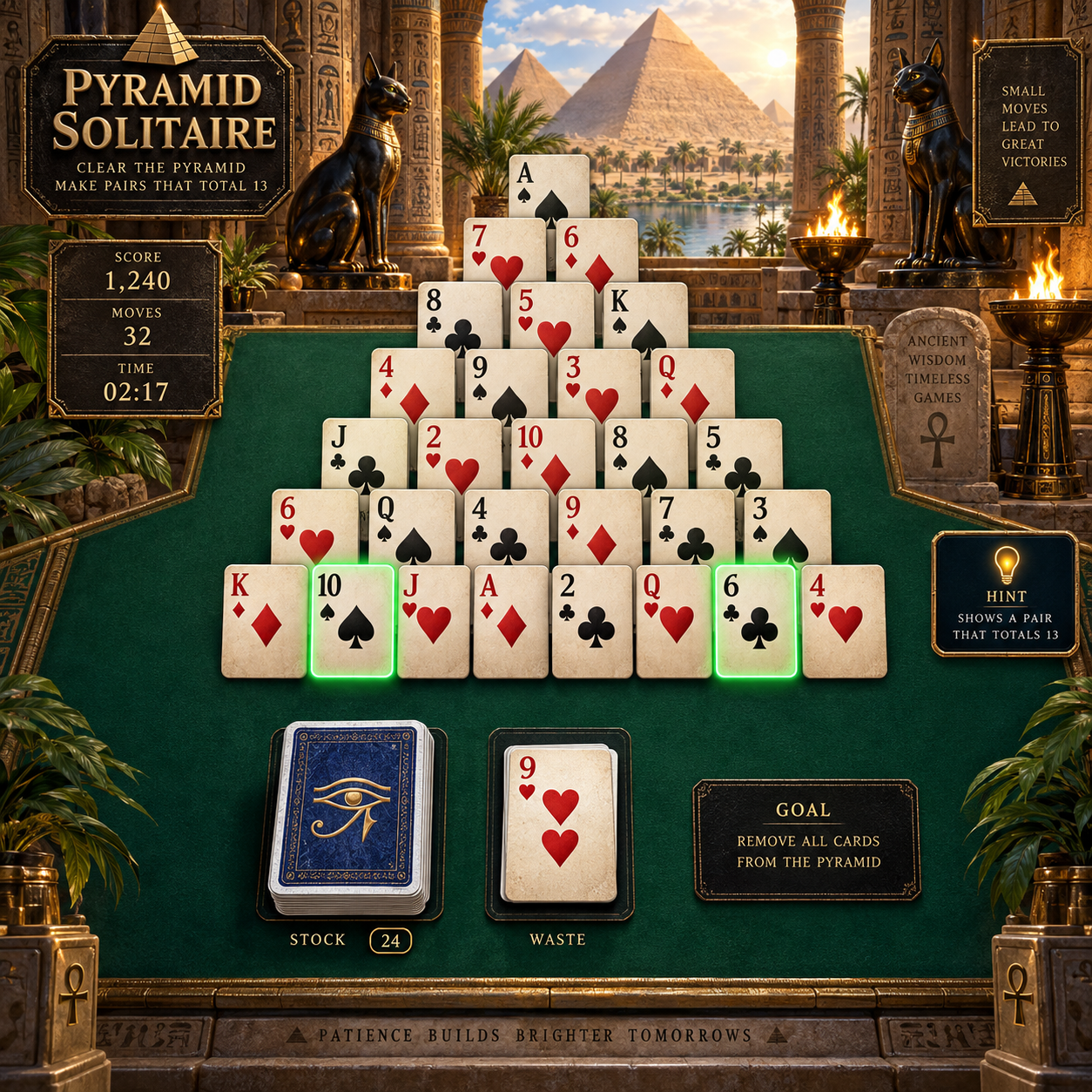
Klondike Solitaire — the classic version most people picture when they hear the word — is particularly effective at generating these near-win moments. The game has a meaningful failure rate even for experienced players. That means you'll regularly get close without succeeding, which keeps the dopamine loop spinning in a way that a game you always win (or always lose) simply can't.
This isn't a flaw in the design. It's the engine.
Variable Rewards and the Power of Uncertainty
The shuffled deck is the heart of solitaire's psychological pull. Because every deal is different, you genuinely cannot predict whether a given game is winnable before you play it — and that uncertainty is the source of its grip.
Psychologists describe this as a variable reward schedule: the pattern where rewards arrive unpredictably rather than at fixed intervals. It's the same mechanism that makes checking your phone feel compulsive, or that keeps people pulling a slot machine handle. The unpredictability itself becomes compelling. When you know a reward is coming, your brain habituates to it quickly. When you don't know, the anticipation stays elevated.
In solitaire, every new shuffle is a fresh unknown. Will this be a winnable layout? Will the cards fall right? That question doesn't resolve until you play — and often not until the very end. The game forces you to stay engaged to find out the answer.
What separates solitaire from genuinely problematic variable-reward systems is the absence of monetary stakes and social pressure. You're not chasing losses with real money. You're chasing a card arrangement with a clean conscience, which puts it firmly in the category of casual gaming psychology — compelling, but low-risk.
Flow State — When Solitaire Becomes Effortless Focus
At its best, solitaire produces a mental state where time disappears and thinking becomes automatic. Psychologists call this flow — a condition of deep, effortless engagement where the challenge level matches your skill closely enough that you're neither bored nor overwhelmed.
Solitaire hits this balance remarkably well. The decisions aren't trivial — there are real strategic choices about which cards to move, when to draw from the deck, and how to sequence plays. But they're also not so demanding that you need to concentrate intensely. The game sits in that productive middle zone where your mind can engage without straining.
This is why solitaire often feels meditative rather than taxing. The cognitive engagement is real, but it operates at a comfortable level. Your attention is occupied just enough to quiet intrusive thoughts without requiring the kind of focused effort that depletes energy. Many people describe finishing a session feeling clearer-headed than when they started.
The short feedback loops in solitaire — each card flip, each successful placement — help sustain this state. You're never waiting long for the game to respond to your choices, which keeps the mental rhythm smooth and uninterrupted.
Control, Autonomy, and Low-Stakes Decision-Making
Solitaire gives you complete control over a contained world, and that's more psychologically significant than it sounds. Every move is your decision. There's no opponent reacting to you, no timer forcing your hand, no other player to blame or credit. The outcome is yours entirely.
This sense of autonomy is a core psychological need. Research in motivation consistently shows that people find activities more satisfying when they feel in control of their choices — even in small-scale, low-stakes environments. Solitaire provides exactly that. You're the architect of every play, and the consequences are contained within the game.
That low-stakes quality matters. In daily life, decisions often carry real consequences — at work, in relationships, with money. Solitaire offers a space to make decisions freely, without cost. You can take risks, try unconventional sequences, or play aggressively, and the worst outcome is a lost game that resets in seconds. This is genuinely relaxing for the decision-making part of the brain, not just the emotional part.
It also explains why solitaire tends to feel satisfying even when you lose. You made the calls. The game played out. There's a clean resolution, which is something real life rarely offers.
Stress Relief, Habit, and the Comfort of Routine
Solitaire functions as a reliable mental reset — a low-effort way to step away from stress without fully disengaging from activity. This is why people reach for it during lunch breaks, waiting rooms, or the end of a long day.
The repetitive behavior involved — drawing cards, sorting by suit, building sequences — has a rhythm to it that many people find inherently calming. It's similar to the way some people find comfort in organizing objects or doing routine physical tasks. The hands are occupied, the mind is gently engaged, and the background noise of anxiety quiets down.
Over time, this turns into habit formation. The brain associates the act of opening a solitaire game with a shift in mental state — a reliable cue for relaxation. Once that association is established, the urge to play doesn't require a conscious decision. It becomes automatic, triggered by boredom, stress, or simply a familiar moment in the day.
This isn't a warning sign. For most people, it's a functional coping mechanism. The question is whether the habit serves you or starts to substitute for things that need your attention — which leads to the only genuinely important question about solitaire.
Is Solitaire Addiction a Real Concern?
For the vast majority of players, habitual solitaire is a healthy, low-stakes routine with real cognitive and emotional benefits. It's worth being honest about when it might tip into something less useful — but that line is much further out than most people assume.
Solitaire lacks the features that make other digital activities genuinely concerning: there's no monetization pressure, no social comparison, no escalating stakes. It doesn't punish you for stopping or reward you for playing longer sessions. The game ends cleanly, and the next one is always identical in structure to the last.
The scenario where solitaire becomes worth examining is when it consistently replaces activities you actually want to do — not when it fills idle time, but when it fills time that isn't idle. If you notice you're using it to avoid a difficult task, a conversation, or a decision that needs making, that's worth noticing. Not because the game is harmful, but because avoidance has costs regardless of what you're avoiding with.
The good news: understanding the psychology behind why solitaire is compelling gives you exactly the self-awareness needed to play it intentionally. You know why you're drawn to it. You know what it's giving you. That knowledge puts you in control of the habit rather than the other way around.
Frequently Asked Questions
Why do I always want to play "just one more game" of solitaire?
The near-win effect is the main driver. When a game ends — especially a close loss — your brain interprets it as an unresolved reward signal. The dopamine loop stays open, and starting a new game feels like the natural way to close it. The variable reward schedule of a freshly shuffled deck makes that next game feel genuinely promising.
Is playing solitaire every day bad for you?
Daily solitaire is, for most people, completely benign. It provides mild cognitive engagement, stress relief, and a reliable mental break. The habit becomes worth questioning only if it's consistently displacing things you actually need or want to do.
Does solitaire actually improve concentration or memory?
It provides light mental stimulation that can sharpen pattern recognition and short-term planning. It's not a substitute for more demanding cognitive exercise, but regular engagement with card sequencing and spatial reasoning isn't nothing either. Think of it as a gentle workout for attention, not a transformation.
Why does losing at solitaire make me want to play again immediately?
Because losing activates the same near-win circuitry as almost winning. Your brain doesn't fully distinguish between "I lost" and "I was close" — both register as unresolved. The impulse to replay is your reward system trying to complete the loop.
What is it about solitaire specifically that feels relaxing?
The combination of low-stakes decision-making, repetitive physical rhythm, short feedback loops, and complete autonomy creates an ideal environment for mild cognitive engagement without stress. Your mind is occupied just enough to quiet anxious thoughts, but not so taxed that it needs recovery afterward. That balance is genuinely rare in everyday activities.